
The TorqueForm as a complex software-based system and the connectivity of all of its components can take effort to comprehend, similar to understanding any complex system such as the human body or a space shuttle. However, due to the advancement of technology, you can now learn and understand more quickly and easily that which took the human race thousands of years to discover and explain. The TorqueForm’s functioning and operation is easier to understand when compared to and visualized as a “mission cyber ship” consisting of a hypersonic jet engine with three wings. The TorqueForm’s launch begins with the “torquing” of self-defeating notions of something being “beyond your ability to understand” into a growth-mindset removing those mental blockades. To demonstrate this, laid out are some engineering basics of supersonic and hypersonic aircraft engines in an easy-to-understand format. Just flip that switch from “I don’t get it” to “I can understand this.”
Model created by Winston Miely with credits to jerryfisher | Sketchfab | https://sketchfab.com/3d-models/bronze-replica-statue-of-liberty-8200b4562e494d0b8aed7e316303e0b8
The mechanistic schematic of the TorqueForm’s virtual hypersonic jet engine diagram is that of a Turbine-Based Combined Cycle (TBCC) with a Dual-Mode ScramJet (DMSJ) hypersonic engine (see directly below). The three wings depict the Tribrid: Luxauro, Gold Metal Guild, and TF Empires and the “extensions” of those wings: Untreadable, Indie Arcadia, and Groundsourcing.
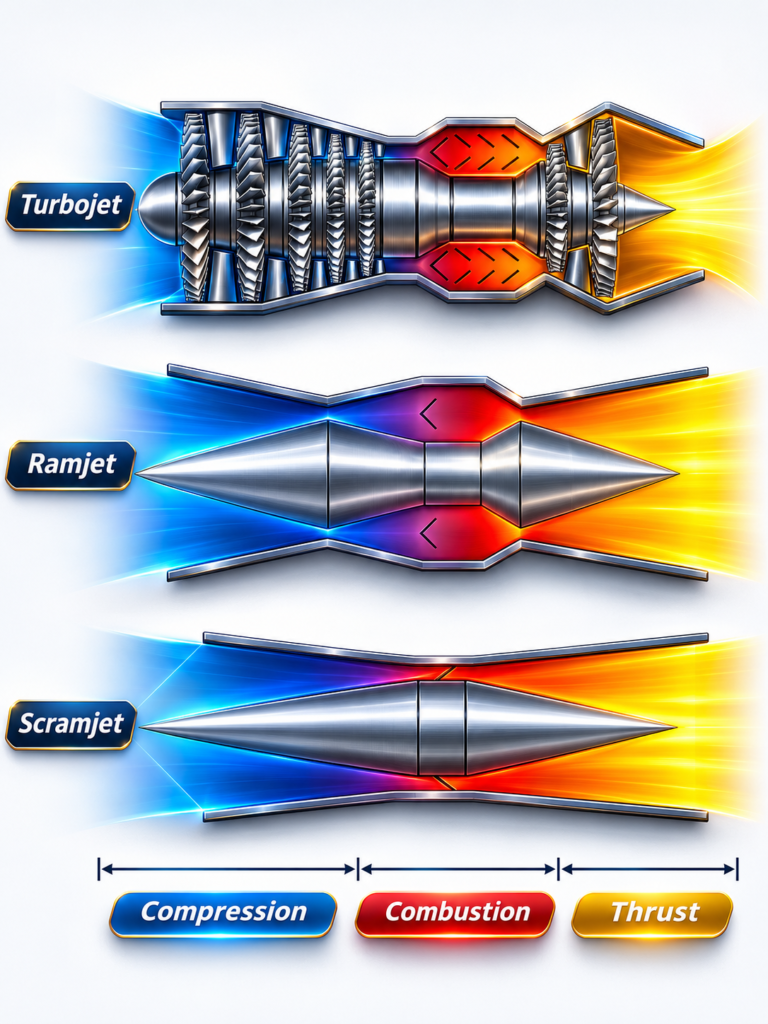
A turbojet engine (top) uses turbines to pull the air (from the left) and compress it to enter the combustion chamber (red) causing it to expand resulting in the thrust (yellow). Turbojet engines are designed to take an aircraft from the ground to approximately mach 3. A ramjet engine (middle) compresses the incoming air against the inlet cone (blue zone) before it passes into the combustion chamber (red) where it ignites the jet blast (yellow). However, a ramjet doesn’t work until speeds of about mach 3 are already achieved. Similarly, the scramjet engine (bottom) also uses the incoming airstream (blue) compressed by the inlet cone, igniting with the fuel (red zone) resulting in the extreme expansion, creating the jet blast or lift ((yellow). Despite the simple design of the scramjet engine, it is the fastest of these 3 models, taking aircraft from approximately mach 6 – mach 12. Still, engineers were left with the problem that the scramjet didn’t work until the aircraft was already flying at least mach 6. Naturally, this difficulty was met with yet another great invention; the combination of a turbojet and ramjet engine together (Turbine-based combined cycle or TBCC), taking the flight from 0 – mach 6, and then finally combining the turbojet with the ramjet with the scramjet, creating a unified turbine-based combined cycle with a dual mode ramjet scramjet (DMSJ) capable of speeds greater than Mach 8.
The air entering into the virtual TorqueForm jet engine is symbolic of all of the products, projects, professionals, shoppers, backers, founders, merchants, everything and everyone that on-boards the TorqueForm.
The “fuel” of the TorqueForm when viewed as a hypersonic jet engine can be compared to the driving force or the constant striving to improve. TF Talk is laced throughout the TorqueForm in an attempt to motivate and inspire people to constantly look up, seek new heights, and “climb higher” in life. Also, the high-level synopsis of XSE is Luxxacation, which can be a catalyst to advancement.
The jet blast which creates the jet propulsion can be compared to the advantageous results of the TorqueForm from the individual to professional level. The more people board the TorqueForm, the more the benefits should be realized (ethically, financially, socially, intellectually, physically, etc) lifting up the human race as a whole, as the TorqueForm’s virtual flight ascends in its mission of integrity and strength.
At the center of the engine is the inlet cone which, being circular and increasing in diameter, represents the concentric seven spheres of integration. The more that the TorqueForm is used, the more that new possibilities will be realized, inviting integration in new ways throughout the 7 spheres.
Engineered using Independent Integration Systems Engineering (XSE) with a focus on the integrity and strength of the individual with the purpose of advancing the human race as a whole. The TorqueForm presents unexplored paths and innovative approaches.

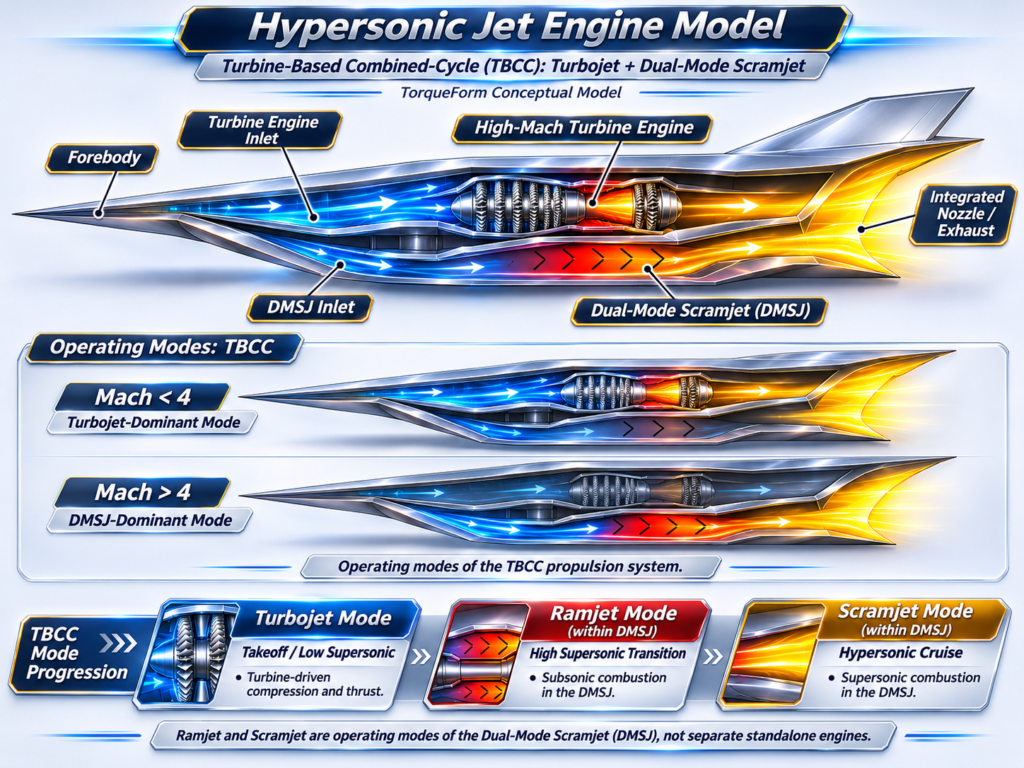
NASA describes the Turbine-Based Combined-Cycle (TBCC) propulsion system as an advanced approach that integrates two different types of engines to propel an aircraft across a broad range of speeds.
The system initially relies on a turbine-based engine to power the aircraft from takeoff through progressively higher speeds, reaching approximately Mach 3 or Mach 4. At this point, the propulsion system undergoes a process known as mode transition, shifting propulsion from the turbine engine to a Dual-Mode Scramjet (DMSJ).
The DMSJ is designed to operate at much higher speeds, functioning in ramjet mode with subsonic combustion and transitioning to scramjet mode with supersonic combustion as flight conditions require. This enables the aircraft to continue accelerating into the hypersonic flight regime.
The remarkable advantage of this combined-cycle approach is the integration of complementary propulsion capabilities into a coordinated system, allowing the aircraft to operate across a much wider speed range than either engine could efficiently support independently.
This engineering concept serves as the inspiration for the TorqueForm’s Hypersonic Jet Engine Model, illustrating how distinct but complementary capabilities can be strategically integrated to support progressive advancement toward increasingly ambitious objectives.

The first Tribrid: Luxauro (multi-vendor e-commerce marketplace) + TF Empires (tailored reward-based crowdfunding) + Gold Metal Guild (capitalized professional networking), built on the TorqueForm. Patent pending.
As part of the TorqueForm’s mission to encourage and promote strength, integrity, and independence, we collaborate with for-profit and non-profit entities to help bring our vision to life. These for-profit and non-profit entities may support each other. Additionally, the TorqueForm may collaborate with these entities on specific projects, initiatives, or events.
It’s important to note that while the TorqueForm and these affiliated for-profit and non-profit entities share common ownership and similar missions and visions, they operate as separate legal entities with distinct objectives and activities. The affiliation between the TorqueForm and these entities does not imply endorsement or promotion of specific products or services.
TorqueForm, CoTFPilot, Triptych Fusion, and -X- Skyway are trademarks of Luxauro, LLC.
Gold Metal Guild is a dba of Luxauro, LLC, and TF Empires is a dba of Goldevine, LLC. For a list of Luxauro and Goldevine DBAs and TMs, click here.
TorqueForm content has been generated in part with AI. In addition, the content available here on TorqueForm is considered to be only general commentary on, for reference purposes, and/or analysis of, the subject(s) addressed and is not a substitute for advice from a licensed professional. At this point in time, since generative AI is relatively new and in-development, and since research is constantly developing and new discoveries are being made all the time, we strongly advise that you independently verify all information contained herein. Any action taken or not taken based on content found here is at your own risk. TorqueForm and its affiliates assume no liability for inaccuracies. If any article cites or provides a link to third-party sources or websites, TorqueForm and its authors are not responsible for and make no representations or warranties regarding such source’s content or accuracy. Additionally, any references to third-party companies, products, or brands on the site does not imply any endorsement or affiliation with said companies, products, or brands. Statements regarding health, diet, supplements, or any similar subject(s) have not been evaluated by the FDA or any health authority and are not intended to diagnose, treat, cure, or prevent any disease or condition. Any opinions expressed in the site content do not necessarily reflect those of TorqueForm. If you have questions, comments, corrections, or information that you would like to submit to us, please contact us here.
